



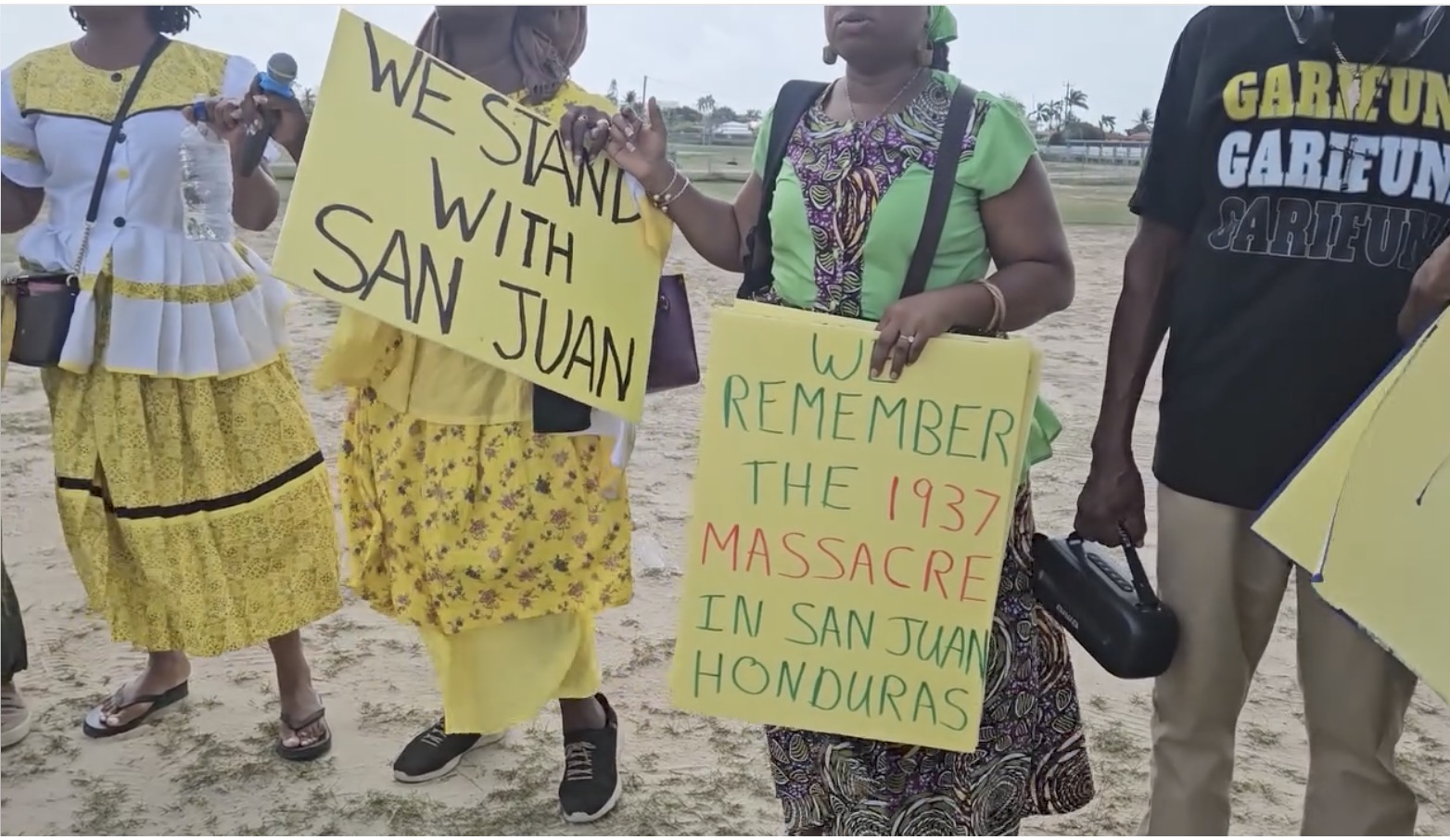
There comes a time when silence becomes betrayal.
That time is now.
The National Garifuna Council has called on Garinagu and all people of conscience to stand in solidarity with our brothers and sisters in San Juan, Atlántida, Honduras, who once again find themselves fighting for something no people should ever have to beg for—the right to remain on their ancestral lands.
This is not merely a Honduran issue.
This is a Garifuna issue.
This is a Belizean issue.
This is a human rights issue.
The Garifuna people of Belize did not emerge in isolation. Many of our families are directly connected to San Juan through blood, marriage, shared history, and sacrifice. Some of our ancestors fled the horrors of the 1937 massacre in San Juan and found refuge here in Belize. They built Dangriga, Hopkins, Seine Bight, Georgetown, Barranco, Punta Gorda, and countless other communities into the cultural heartbeat of this nation.
Today, history threatens to repeat itself.
Military intimidation. Threats of dispossession. Indigenous people being forced to defend the very land their ancestors occupied long before modern governments existed.
That should outrage every Belizean.
I stand in full solidarity with the National Garifuna Council.
But solidarity cannot stop with a peaceful march.
Where is the Government of Belize?
Where is the Prime Minister?
Where is the Minister responsible for Indigenous Affairs?
Where are the ministers and area representatives elected by thousands of Garifuna voters across southern Belize?
I am calling specifically on the Area Representative for Dangriga, Hon. Dr. Louis Zabaneh, along with every southern minister and representative whose political success has been built on Garifuna communities.
Your voices matter.
Use them.
Demand that the Government of Belize publicly condemn the intimidation taking place against the Garifuna people of San Juan.
Let us hear the Prime Minister himself declare that Belize stands with the Garifuna people of Honduras.
Anything less sends a dangerous message—that Indigenous lives and Indigenous lands are negotiable.
For generations, the Garifuna people have given this country far more than our numbers would suggest.
We have enriched Belize through culture, music, education, public service, sports, business, tourism, and national development.
We have defended this nation’s democracy.
We have helped build its identity.
We have represented Belize proudly across the world.
So why is it too much to ask that Belize now stand with us?
History reminds us that Belize opened its doors to people fleeing conflict elsewhere in the region, including many families escaping civil war in El Salvador. That humanitarian response reflected the best of who we are as a nation.
If Garifuna families in Honduras are ever forced from their ancestral communities by persecution or dispossession, should Belize not also be prepared to extend compassion?
Should we not explore lawful pathways for Garifuna families seeking refuge to live, work, and even own land here in Belize?
Such a discussion would require careful planning, consultation, and respect for Belize’s laws and land policies. But it is a conversation worth having—not because Garifuna people deserve special treatment, but because protecting vulnerable Indigenous communities is consistent with the values Belize has long claimed to uphold.
Belize still has an opportunity to lead by example.
This is bigger than politics.
This is bigger than elections.
This is about protecting a people whose survival has depended on resilience for more than two centuries.
Our ancestors endured exile.
They survived slavery.
They survived massacres.
They crossed the sea to preserve who they were.
We owe them more than silence.
Today, our brothers and sisters in San Juan need to know they are not standing alone.
Belize must find its voice.
And history will remember whether we used it.
