



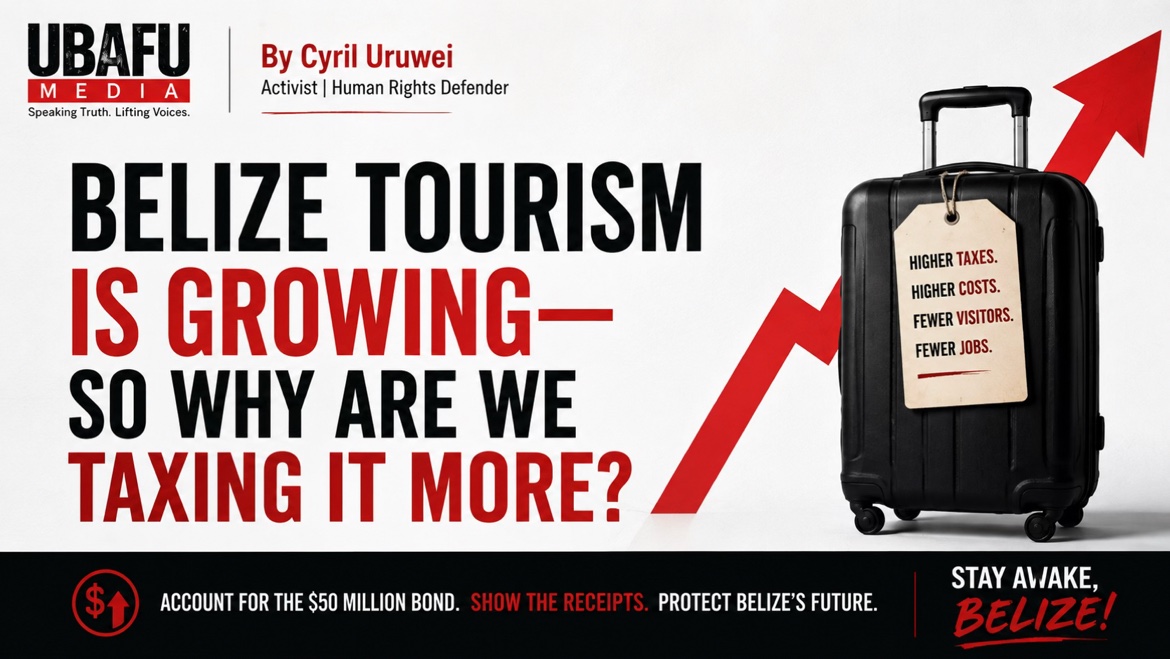
There is a dangerous habit developing in Belizean governance: collect first, explain later.
And Belizeans should reject it—regardless of which political party occupies Belmopan.
The proposal by the Belize Tourism Board (BTB) to increase the hotel accommodation tax from 9% to 12% cannot simply be treated as another three percentage points on somebody’s hotel bill.
Going from 9% to 12% represents a 33.3% increase in the tax rate itself.
So before Government reaches deeper into one of the most important engines of the Belizean economy, there are some questions that deserve answers.
Why is the additional money needed?
How much additional revenue is expected?
Where exactly will that money go?
What economic analysis has been conducted to determine the effect on tourism demand?
And perhaps most importantly:
What accountability exists for the tourism money already entrusted to those institutions?
Those aren’t PUP questions.
They aren’t UDP questions.
They are Belizean questions.
Tourism Is More Than Hotels
When politicians and policymakers speak about tourism, too often the conversation becomes reduced to arrival numbers, hotel occupancy and investment figures.
But tourism in Belize has a human face.
It is the tour guide waiting for another booking.
It is the taxi driver at the airport.
It is the woman selling food.
It is the fisherman supplying a restaurant.
It is the farmer supplying produce.
It is the craft vendor.
It is the small guesthouse owner.
It is the water taxi employee.
It is the domestic airline worker.
It is the cultural performer.
And here in southern Belize, it is also the Garifuna drummer, cook, guide, artisan and entrepreneur whose culture has become part of the very product Belize markets to the world.
When tourism sneezes, these people catch the cold long before the people sitting comfortably behind desks in Belmopan.
That is why this conversation cannot simply be about whether tourists can afford another few dollars.
The question is what happens throughout the entire tourism ecosystem when Belize becomes more expensive.
A visitor working within a fixed vacation budget does not magically create more money because government introduces another tax.
Something gives.
Maybe the visitor stays one fewer night.
Maybe they skip a tour.
Maybe they eat at the hotel instead of a community restaurant.
Maybe they buy fewer crafts.
Maybe they choose cheaper accommodation.
Or maybe they compare the final price of Belize with Mexico, Guatemala, Costa Rica, Jamaica or another Caribbean destination—and simply go somewhere else.
That possibility deserves serious economic analysis, not political reassurance.
Show Us the Data
Government should not be afraid of scrutiny.
In fact, good government should welcome it.
If the BTB has conducted research showing that increasing the accommodation tax to 12% will generate substantially more revenue without meaningfully affecting occupancy, visitor spending, employment or Belize’s competitiveness, then publish it.
Let Belizeans see it.
Let economists examine it.
Let tourism stakeholders challenge it.
Let journalists question it.
Let the public understand it.
Tell us the projected additional revenue.
Tell us what assumptions were used.
Tell us how different categories of accommodation could be affected.
Tell us what percentage will actually reach tourism development projects.
And tell us what measurable results Belizeans should expect from every additional dollar collected.
That is how democratic government is supposed to work.
Public institutions should not fear informed citizens.
And Then There Is the $50 Million Question
There is another issue that cannot simply disappear because the news cycle moves on.
Questions have been raised regarding the $50 million tourism infrastructure bond and calls for an independent accounting of how those funds were raised, administered and spent.
Before Belizeans—or visitors to Belize—are asked to contribute additional money, those questions deserve clear answers.
If everything was properly administered, then an independent audit should strengthen public confidence.
So where is it?
Publish the accounting.
Publish the projects.
Publish the expenditures.
Publish the outcomes.
Show Belize the receipts.
Accountability should never depend on who occupies the Prime Minister’s office or who sits on the Opposition benches.
If we demand transparency from one administration and suddenly become quiet when “our side” controls government, then we were never fighting corruption.
We were fighting opponents.
There is a difference.
Dangriga Must Pay Attention
For those of us in Dangriga and southern Belize, this debate deserves particular attention.
We sit in one of the most culturally and naturally rich regions of this country.
Dangriga is marketed as the Culture Capital.
Hopkins has become an internationally recognized tourism destination.
Placencia and the wider south contribute substantially to Belize’s tourism product.
Our Garifuna culture, food, music, language and traditions help distinguish Belize from virtually every competing destination in this region.
Yet we must continually ask:
How much of the wealth generated from these assets actually remains in our communities?
If additional tourism revenue is going to be collected, southern Belizeans should be demanding to know what portion will strengthen community tourism, cultural preservation, beaches, roads, drainage, public spaces, heritage sites, sanitation, small enterprises and the infrastructure visitors and residents actually use.
You cannot continuously market our culture while economically marginalizing the people who keep that culture alive.
Culture cannot merely be decoration for somebody else’s tourism product.
It must become an instrument of economic empowerment for the communities that created it.
Consultation Cannot Be Theatre
The Belize Hotel Association and Belize Tourism Industry Association have raised objections to the proposed increase.
Government does not have to automatically agree with them.
But it does have an obligation to listen.
And consultation cannot mean inviting stakeholders into a room after the major decisions have already been made.
That is not consultation.
That is notification with refreshments.
Meaningful consultation means putting the evidence on the table, allowing stakeholders to interrogate it, considering alternatives and demonstrating how legitimate concerns affected the final policy.
That is particularly important when livelihoods are involved.
This Is Bigger Than 3%
This conversation should not become another PUP-versus-UDP shouting match.
Belize deserves better than that tired political theatre.
The deeper question is about how we are governed.
Should government be able to increase the financial burden on an important sector without first presenting compelling evidence?
Should institutions collecting millions of dollars from the public be required to demonstrate how those funds are being spent?
Should major policy decisions be accompanied by independent economic assessments?
Should ordinary Belizeans have access to the information necessary to determine whether government policy is actually working?
My answer is simple:
Absolutely.
Transparency is not a favour politicians grant us.
Accountability is not disrespect.
Questioning government is not anti-government.
And demanding evidence is not obstruction.
These are basic requirements of democratic governance.
Before You Take More, Account for What You Already Have
Perhaps the proposed increase can ultimately be justified.
Perhaps the additional revenue could strengthen Belize’s tourism infrastructure, protect our natural resources, improve destination management and expand opportunities for Belizean businesses.
If so, make the case.
With evidence.
Not slogans.
Not press releases.
Not political talking points.
Evidence.
Publish the economic impact assessment.
Explain exactly how the additional revenue will be spent.
Establish measurable targets.
Commit to regular public reporting.
Address the concerns surrounding the $50 million tourism bond.
And meaningfully engage the people whose livelihoods depend on this industry.
Because Belize cannot keep demanding more from citizens, businesses and visitors while demanding less accountability from the institutions entrusted with their money.
That equation is backwards.
Government works for the people—not the other way around.
And whether the government of the day wears blue, red, green, or any colour yet to be invented, the standard must remain the same:
Show us the evidence.
Show us the numbers.
Show us the results.
Show us the receipts.
Tourism is too important to Belize—and to thousands of working Belizeans—to govern it by assumption.
Stay awake, Belize.
— Cyril Uruwei
Activist | Human Rights Defender | Host, Dangriga Unmuted
UBAFU Media
